The Dragonfly Forest

They have been given names such as devil’s darning needle, ear sewer, horse stinger, skeeter hawk, and the snake’s servant. Actually, Dragonflies are beneficial, peaceful, and stunning. You are a Dragonfly if you are: ADD/ADHD, dyslexic, dysgraphic, Asperger’s, NLVD, autistic…

Showing posts with label adhd. Show all posts

Tuesday, October 17, 2017

How my disabilities are also my superpowers... Sharing my story!

It is Dyslexia Awareness month and I want to share my story...

My story:  Jill Marie-Grandstaff Lam (because I am dyslexic and ADD I don't eye-read fast so I added a lot of short video clips to help tell my story).

Dyslexia, dysgraphia, and ADD (plus anxiety and depression) are genetic and strong in my family tree.  Like many others, I didn't know what was wrong with me or the names dyslexia and dysgraphia.  I also didn't know that I had Attention Deficit Disorder, I just thought everyone lived in the thoughts in their head.  Here's an example of me in school and even now - 

I could always relate to these Ralph Phillips cartoons!  My mind wanders because it thinks in creative ways.  I tend to get lost in the stories in my own brain.  Someday, I'd love to take time to write these stories down but due to my dyslexia and dysgraphia, that process isn't easy.

I still don't know my math facts (times tables) and it wasn't because I was daydreaming during the lessons it was due to being dyslexic.  My rote memory just isn't there.  School was also challenging because I struggled with reading.  I have NEVER been able to sound out an unknown word.  I was taught Whole Language (insert eye-roll here and if you are educated about dyslexia I bet you did the eye-roll all on your own) and therefore was not taught phonics.  I didn't even learn how to say some of the letter sounds correct until my own children were going through their private Orton-Gillingham tutoring.  I will probably never be able to write a haiku poem because I have no idea how to separate words into syllables.  People who can break words into syllables always try to teach me to do this after they learn that I can't but what they don't understand is I really CAN'T.  When people do this I wonder if they would try to make a person who can't use their legs walk just because they themselves can walk. The same thing happens with learning a foreign language.  I struggle with pronouncing English words so foreign words are even worse, yet people who speak another language make an assumption that I'm just not trying hard enough.  I am trying as hard as I can! Finally, my reading fluency sucks.  I can't even get half-way through the subtitles of a movie before the screen changes. I had to see each of the Star Wars movies 12 times before I completely read the opening words- (okay, those of you who know me well know I was thrilled to see each one a dozen times).  

Yes, I struggled immensely in school from kindergarten to my Ph.D. program. Oh heck, I struggle every day with my disabilities!  I could share some stories of heartache and pain, stories about how I never fit in and worked hard to hide my disabilities; but I will not share these stories today.  I want to share with you 3 SUPERPOWERS I have BECAUSE of my disabilities. 

1:  The Superpower of Empathy
My brain is not able to process language like a non-dyslexic brain but I have more mirror neurons than my peers which means I experience deeper levels of empathy.  I knew from very early on that I felt the feelings of others.  I used to take these feelings on as my own because I didn't know the difference between the other person's feelings and my own feelings. Here's a video of mirror neurons and empathy to help you understand!   
So how do I know I have more mirror neurons and excess empathy?  I wish I could explain it or even prove it scientifically but I can't right now (working on that).  I just know.  Over the years I have developed this sixth sense so well that I am able to read even subtle body language and facial expressions of others.  When I meet people I can tell exactly what they are feeling and experiencing.  I can sense those around me that have this similar Superpower and it is often very strong in people with dyslexia.  Let me point out that not everyone has this as a Superpower or even a strength.  They may think they do because they have some mirror neurons and can show empathy but it is very different than what I am talking about; what I mean is an exceptional level of being able to feel exactly what another person is experiencing.  For those of you who have it to this degree - you know exactly what I mean. 

2:  The Superpower of Acceptance
I not only have an abundance of mirror neurons and empathy because these are the strength of my brain, but I was also raised by parents who also have a brain wired for extra mirror neurons and empathy.  My parents taught me to accept EVERYONE and to help those in need.  I was blessed with acceptance and not judgment. I was taught the love of ear-reading and given audiobooks to listen to from Zig Ziglar, Earl Nightingale, Dale Carnegie... and many more.  I was taught about Leo Buscaglia and his values.   I live my life based on the teachings of Leo even when people are mean to me or treat me bad.  Oh, you don't know Leo Buscaglia?  Well then, here's a very short clip of him in action:
Doesn't he just make you smile?  Well, that's my reaction.  I have an intrinsic passion for the inclusion of everyone.  

3:  The Superpower of Tenacity
Having dyslexia, dysgraphia, and ADD (plus anxiety and depression) is not easy and as a child, I didn't know anyone else like me so I knew that I was different.  I was on a quest to find others like me, as well as, to find the real ME.  I searched for answers in movies and books.  In high school, I found the answer in Joseph Campbell's book The Hero with a Thousand Faces and knew that I was on my own Hero's Journey!  I learned we are all on our own Hero's Journey and each movie and book took me on these adventures. The characters in these books and movies are like friends to me.  I am not an outsider looking in but immersed in the stories as if I too were living them and experiencing the same adventures. I mastered my own Superpower skill of Tenacity!  I don't give up.  Watch my friend, Samwise Gamgee, explain exactly what I mean to Frodo Baggins:

Yes, I am a person with dyslexia, dysgraphia, and ADD (plus anxiety and depression) but I am also a person with many Superpowers- Empathy, Acceptance, and Tenacity.  In elementary and junior high my life was filled with shame and exclusion.  In high school when I became "friends" with Joseph Campbell I heard my calling to help others.  Like many, I refused this calling. I thought, who was I to help others- I am not worthy.  Due to my inner tenacity, I took the leap of faith and headed off to college to pursue a degree in Psychology (I also have minors in Health Education and Marketing).  With the help of all my Supernatural Aids (the characters of my movies and books), I went on to get a Master's degree in Clinical Counseling and became a Licensed Professional Clinical Counselor with supervisory status and then entered Crossing the Threshold into the working world.  I was taught how to diagnose all types of learning disabilities, worked in many areas of special education as a therapist, and eventually, I entered the Belly of the Whale by opening my own private practice as a Psycho-educational Diagnostician and Counselor in 2007- Forest Alliance Coaching (and Forest Alliance Coaching FB page).  On my journey of helping others I have been down many Roads of Trials and I'm still on these roads but I have the tenacity to just keep going. I now have my Ph.D. in Psychology with a specialization in Educational Psychology.
As I continue my journey I have ventured into many other areas where I can help others live a better life.  A few years ago I started The Dragonfly Forest a blog where I can share insights and motivate others who are different and often have disabilities (ADHD, Dyslexia, Dysgraphia, Asperger's...).  Through The Dragonfly Forest blog, The Dragonfly Forest FB page, and my private practice I have become even more involved in the disability community and now have Dragonfly friends all over the world.   

In early February 2013, I read about the Decoding Dyslexia movement in New Jersey and knew I was receiving another calling (one I didn't hesitate to answer).  I contacted Deborah Lynam from DD-New Jersey and got started on Decoding Dyslexia Ohio by making a commitment to DD-NJ and then starting Decoding Dyslexia here in Ohio and created the Decoding Dyslexia Ohio Facebook page.   The DD-OH journey has been an exciting one and I know that I was guided this way so I can continue to help make the lives of others a better place.  I meet with the wonderful parents of children with dyslexia in Ohio and look forward to sharing this journey with them.  The parents have been such a great support system as well and these parents suggested there be another Facebook group that focused Family Support (since the website and other FB pages were focused on school and legal issues) so DD-OH Family Support Group page was started.  I am so excited by all the adventures we will be having on this DD-OH journey and thrilled that God, the Higher Power, or the Universe guided me in this direction. 

Here is one final video that I think really supports my life's journey and my Superpowers. Some of you will recognize a young Ben Foss (it was filmed in 2003 btw).   I love being on this journey with some great people like this - and YOU!  Thanks for sharing this journey with me! 

(Image: photo of me, Dr. Jill Lam with Ben Foss both standing and smiling at the camera)


(Image: my own photo of a blue and green dragonfly and my own quote: "Be proud of who you are because you are great!")




Thursday, January 12, 2017

What the brain looks like for ADHD, OCD, PTSD & DEPRESSION


So sad that people just don't understand that the brain is connected to all these things - ADHD, OCD, PTSD, DEPRESSION, & even ANXIETY.  Many people think that it is made up and we don't have a disability.  There is actually a problem in the brain.  Yes, we can make changes to the brain through our thoughts and learning ways to control our bodies reactions but it take a lot of time and practice.    

Friday, January 6, 2017

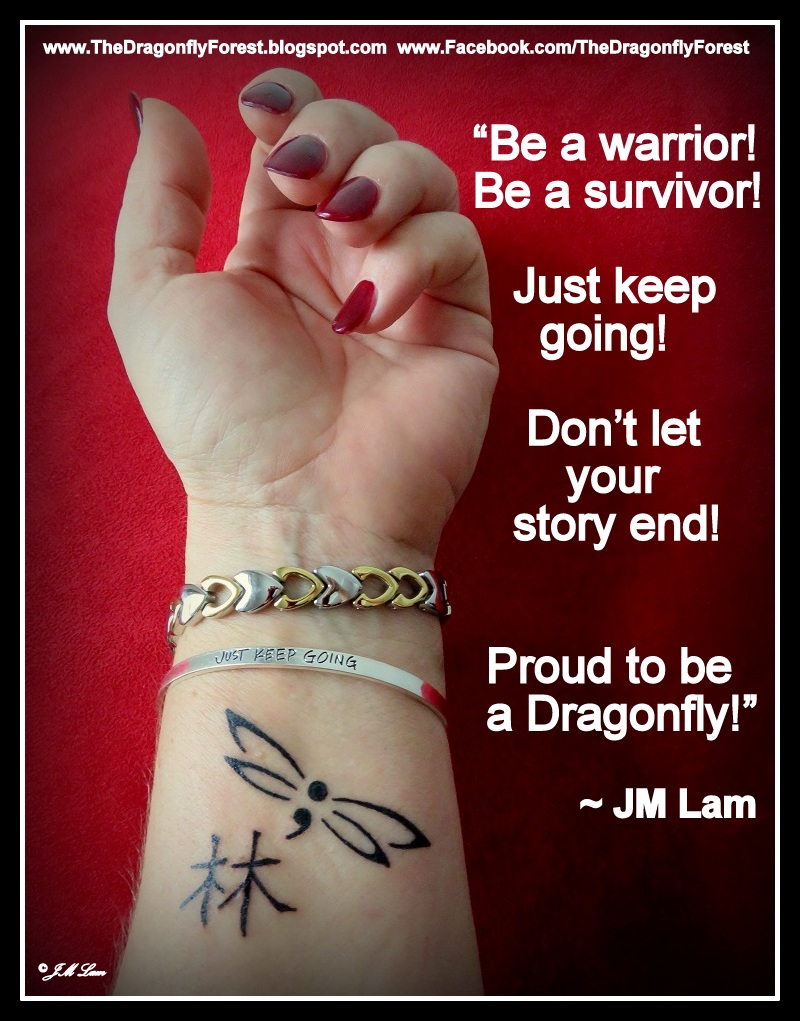
My story is not ending - Project Semicolon & my tattoo

I know that tattoos are not for everyone but I have wanted one for a while & yesterday I finally got my tattoo.  I am thrilled to finally get this tattoo because it has so much meaning for me!  

I have shared openly about my disabilities in a past post- Who I Am. BTW, I am not ashamed to use the word 'disability' because to not use the word disability I would be denying the problems I experience with depression, anxiety, dyslexia, dysgraphia, & ADD.  Here's a better post on Why it is better to use the word disability instead of difference.  Society needs to stop making it shameful to use the words disability & mental illness!  

This is why my tattoo is so important to me!  I got my tattoo to own my struggles with depression & anxiety.  I also want to openly show my support for others who have these battles. Being open will hopefully reduce the shame & stigma around mental illnesses.  As a therapist people often think that we are the ones that have it all together and never experience depression & anxiety but that is not true. The professions of psychology & counseling often have some of the highest suicide rates.  I believe one of the reasons is because we are told it is not okay to disclose our own challenges.  Well, I am for full disclosure & I am open with my clients - I let them know that I have these as well & I can assure them that life is worth living when we have support & learn to accept exactly who we are.  

So, let me explain my tattoo to you!  This tattoo is my Dragonfly Forest (visit my FB page at The Dragonfly Forest & my private therapy practice FB page at Forest Alliance Coaching).  For those of you who don't know my married name is LAM and it means Forest in Chinese - these are the Chinese Characters for Lam/Forest. The Forest (woods) is also my escape & the place I go for inner salvation. The Dragonfly is the symbol of who I am & I'm proud to be a unique amazing Dragonfly!  The body of my Dragonfly is a Semicolon.  It is to represent that my story isn't over! It stems from Project Semicolon.  Project Semicolon is a nonprofit movement started by Amy Bleuel to honor her father, who took his own life.  It is to bring awareness & shame reduction to those who battle depression, suicide, addiction, anxiety, & other mental illnesses.  Here's the reason a semicolon is used - "A semicolon is used with an author could've chosen to end their sentence, but chose not to.  The author is you, and the sentence is your life." 

My goal is to continue to openly discuss the topics that people would rather keep hidden - learning disabilities & mental illnesses. We have nothing to be ashamed of because we have more battles to fight than others. We will have less battles to fight when there is no longer discrimination and negative stigmas about having a disability and/or mental illness.  

Be strong & Be proud!  

(Image description: photo of my left arm wearing a heart linked gold & silver watch & a bracelet that says "Just Keep Going" and my tattoo of a dragonfly with a semicolon body & the Chinese Character for Lam (my last name) which means Forest. On the right side of the picture is my own quote "Be a warrior! Be a survivor! Just keep going! Don't let your story end! Proud to be a Dragonfly!")


Sunday, October 23, 2016

What it might be like to have dyslexia

October is Dyslexia Awareness month so this article will help you understand what it might be like to be a person with dyslexia.  I used the words “might be like” because one of the first thing to understand is that dyslexia is different for each person.   Everyone is an individual and the brain is a unique as a person’s fingerprints; no two are alike! 


Let me explain in a simple way how the brain processes language.  

This is the NON-DYSLEXIC brain working.  When the person sees the words on the page they quickly go to the language center of their brain.  In the non-dyslexic language center the information (letters, sounds, numbers, colors...) are all stored in an orderly sequential way so that each piece is easy to retrieve. Having an organized language center makes learning, especially learning to read fairly easy.


The language center of a person with dyslexia is very different.  
Here the person sees the words on the page and goes up to their language center of their brain to find the corresponding letters and sounds.  When they get to their language center, it is not organized.  Depending on how dyslexic they are, their language center can range from having only a few things out of place to major chaos.  If the person also has ADD/ADHD there may be even more difficulties.  A person with dyslexia doesn't often come back quickly with information because they are sorting through all the mess in their language center to find just the right words, letters, sounds, numbers...  This can be seen when a student has low reading fluency and/or difficulties with Rapid Automatic Naming (RAN). Since the language center is disorganized the person often struggles with sounding words out and may read the words incorrectly.  A great deal of time they will just guess a word based on beginning letters and the shape of the word because it is very time consuming searching all over their language center for just the right match.  


Hopefully this gives you an idea of what it might be like for a person with dyslexia.  If you look up on the internet what it is like to be a person with dyslexia you may come across some activities that "simulate" dyslexia.  I'm not a fan of these "simulations" (explained below) but what I hope you get from these is an understanding of the frustration and feelings of learned helplessness (important topic to understand) that comes from being a person with dyslexia. 

So, why am I not a fan of some of these simulations?  Well, for a few reasons.  As I pointed out before, every person with dyslexia is different and often these "simulations" give the impression that these experiences are universal and they feed into many myths.

The first one I don't like is the one where the people have to read from a paper where the letters are backward, squiggly, or missing parts.  The point is to demonstrate how hard a person with dyslexia has to work in order to read.  The problem with this simulation is the way the letters are presented.  For the most part, people with dyslexia do NOT see things differently.  It is NOT a vision problem.  True, there are some people who also have difficulty with convergence or have eye problems but this is NOT dyslexia.  A better way to present this activity is to try to read something in a foreign language that you do not understand, especially out-loud. These are real words and in order to read them you have to know the phonetic codes that go with each letter and foreign language. Try this:


The other simulation I'm not fond of is the "mirror writing."  Again, this is to show how frustrating it is for the person with dyslexia to share their thoughts on paper but it also adds to the myth that people with dyslexia have difficulty with their vision.  Also, not everyone with dyslexia also has dysgraphia.  Dysgraphia is often common in people with dyslexia but some people with dyslexia are great at writing (penmanship & written expression).  Most people don't even know about dysgraphia which is similar to dyslexia. See, in writing there are also a lot of steps the brain has to go through to process the language and tell the hand how to form the letters, space the letters, spell the words, formulate the sentence, and express thoughts.  Some people may be dysgraphic and not dyslexic - remember everyone is unique.  Doing the mirror activity can be very confusing for people.  A better way to simulate the difficulties with writing for some people with dyslexia is to have people listen to a few sentences in different foreign languages (ones they do not know) and have them write down what they are hearing.  Remember that most adults have learned to adjust to the most non-phonetic language, English so for some people this task may be fairly easy. So to add to the challenge have participants write with their non-dominant hand and go quickly so there is no time to sit around an think.  It is also good to have the sentences to be dictated by someone who fluently speaks that language.

Thanks for still reading this post.  I know it is long and I made it that way on purpose.  People with dyslexia don't like to read because it over works their brain. This is called cognitive overload.  When students are in school all day they will experience cognitive overload.  These students are working 2, 3, and sometimes even 4 times harder than their non-dyslexic peers but it is not often obvious.  So only when a non-dyslexic person (parent or teacher) understands this then changes can be made to the way the person with dyslexia is viewed and treated.  I hope you now have a better understanding of what it might be like to be a person with dyslexia.

Finally, the very best way to know what it is like for a person with dyslexia is to ASK them!  Have them explain what it is like for them in school or work.  They will have the most accurate insight into what it is like to be a person with dyslexia.    


Monday, March 21, 2016

5 things a great coach needs to know!

Spring sports are starting!! I wrote this article because I understand sports from a varieity of perspectives! I have 3 children who have played almost all team & individual sports 2 of them are die-hard soccer players.  I have been a coach's wife for many years as well- my husband coached our children in some of their little league sports but mainly coached middle school teams.  Finally, I have a Ph.D. in psychology with a specialization in educational psychology.  In an interview regarding the 2014 World Cup the US Men’s National Team Soccer Coach, Juergen Klinsmann stated – “We cannot win the World Cup because we are not at that level yet.  For us, we have to play the game of our lives seven times to win the tournament.”  This comment and some personal experiences got me thinking about sports psychology.

Sports psychology is vital in the world of sports just like educational psychology is essential in the world of education.  The two are almost identical except in different arenas.  Sadly, both of these psychologies are not utilized well and most of the time the key figures (administrators, teachers, coaches, and directors of sports program) have little if any knowledge of how utilizing psychology is the first pathway to success.  True, these people may have had some exposure to the concept of psychology in their fields (education or sports) but they all seem to lack an in-depth understanding so they can proficiently incorporate it in their teaching and coaching. 

What is even more devastating is how people in the sports world are even more ignorant about people with hidden disabilities; Asperger’s, Attention Deficit Disorder, Dyslexia…  A person may have exceptional athletic talent but they will never reach their athletic potential because coaches along the way are uninformed and ill-informed about these types of disabilities.  Coaches often don’t even realize that a player has one of these hidden disabilities because these disabilities are not often obvious just by looking at the person.  Just as a teacher can make or break a student, a coach has the power to make or break a player.  I know many great athletics who never made it to their highest level of performance all because they had uneducated coaches along the way.  A team can have all highly skilled players yet not win games because an ineffective coach is damaging the players psychologically.

I’m pretty sure the US Soccer Coach, Klinsmann was telling the world his team isn’t as good as the other teams and has no chance to win the World Cup because he is using psychology to get into the minds of his players and opponents.  The opponents will come into the game of play overconfident and this may be their downfall.  Coach Klinsmann may think that he is doing what Herb Brooks, Coach for the US Men’s National Hockey Team did years ago.  In the 1980 Winter Olympics, Coach Brooks publicly belittled his players and even stated “Unless the ice melts, or unless the United States team or another team performs a miracle, as did the American squad in 1960, the Russians are expected to win the Olympics gold medal for the sixth time in the last seven tournaments.”   The Russians were overconfident and the players were upset with their coach so they bonded together and did create a miracle by winning gold.  What Coach Klinsmann  actually did though was creating a self-filling prophecy.  Remember, I write frequently that “What we focus on we expand.”  Coach Klinsmann got exactly what he has predicted because that is what they were all focused on, especially if the coach and the players believe there is no chance of winning. The USA Men's team was knocked out by Belgium in Round 16.  

These USA soccer players were supposed to be the top players in the US but maybe these soccer players are not the best of the best athletically but the players who with more athletically skills had a bad coach or two early on and was never given a chance or they quit. Some coaches believe that this is a good thing because the weak minded are weeded out.  Unfortunately these are the players that could be the best in the world if coached with a positive psychology approach.  The brain is not designed to handle being broken at such a young age. Being broken early is very common for players who have a hidden disability.  I have worked with some very talented athletics that have been broken by coaches or not given a chance because the coach have a negative confirmation bias or the player is struggling academically and doesn’t have the GPA to even be allowed to play. 

There are athletics with disabilities that have become very successful such as: Michael Phelps (ADHD), Terry Bradshaw (ADHD), Bruce Jenner (Dyslexia), Greg Louganis (Dyslexia), Molly Sullivan Sliney (Dyslexia), Anthony Crudale (Asperger’s), Clay Marzo (Asperger’s) – the list could go on and on…  But for every athlete that reaches the top level there are hundreds of talented athletes who never make it that far because of negative experiences often related to coaching.  

The reason these players made it this far is they had some coaches that believed in them and helped build their self-esteem.  They had at least one coach devote time to their development.  When a coach takes time to really focus on developing a player they get better.  If the coach doesn't put effort into the player and treats the player poorly then they don't improve or get worse - it's the Matthew Effect (the rich get richer and the poor get poorer). 

Many assume that all a coach needs to know is the sport and how to teach the players the technical and tactical aspects of the specific sport.  This is wrong, the most important part of making a successful player and team all relates to psychology. 

So, here are 5 things every coach needs to know to improve players and have a strong winning team.  Since the coach has the power to create or destroy a player’s athletic success it is vital to know what to look for in a coach or things to strive for if you are a coach. 

1-   Every team will have players with a hidden disability.  Yep, that is correct!  One out of five is dyslexic so if you have a team of 10 players there’s a good chance at least 2 are dyslexic.  Parents are often not going to disclose their child has a disability for the following reasons: they may not even know their child has a disability, they may be afraid their child will be labeled or stigmatized, they know that the coach isn’t as knowledgeable as they are so the coach may be very misinformed (the coach may believe that if a player has dyslexia that means they are not very bright), or they may worry that their child will be treated differently.   What a great coach should do – become educated on ADHD, Dyslexia, Asperger’s… there are plenty of resources on the internet.  A good way for clubs to educated their coaches is to have someone like me (an Educational Coach & expert on all types of hidden disabilities) come in and do an educational professional development workshop to teach the coaches about these disabilities; what they are, how they may appear on the field/court, and strategies to use to help these players reach their athletic potential which in turn will produce more successful teams. Coaches often ask why they should care if a child has a hidden disability and the answer to this is - if you know then you will be a more effective coach.  For example, if you know that a player has dyslexia then you will have a better understanding why they confuse their left and right and they will learn quicker if you demonstrate using the foot/hand you want them to use instead of telling them with words (or telling the player to go "inside" instead of saying go left).

2-   What you focus on will expand – so focus on what you want and refrain from focusing on what you don’t want.  Having 3 children all involved in sports this is a common mistake I see from almost every coach.  What happens is a coach will tell a player to stop doing something or to not do something.  For example, on the soccer field I have heard coaches say things like: “don’t kick to the goalie,” “don’t kick the ball more than 2 times,” and “why did (or didn’t) you pass.”  These type of comments cause the player to focus on what you don’t want them to do.  The way the brain is designed, the brain will focus on the action you are describing and the words they can visualize as pictures. So, if you want a player to perform a specific action then you need to tell the player explicitly what action you want them to perform.  If the coach tells the player “away from the goalie” the player will still be focused on the “goalie” and therefore will kick the ball to the goalie (it’s just the way the brain works).  So the best way to phrase this would be “Kick to the net, shoot to the net, focus on the net…” See, you get the picture – YOU can create the picture.  This is especially true for players with hidden disabilities because they respond best when given explicit instructions of what to do and can visualize the play.  What a great coach should do – Pay attention to what you are saying.  If you want your players to perform well then what you say to them matters.  Tell players explicitly what you want from them in a positive way. 

3-   Belittling, degrading, and demeaning does NOT work!  There is some old-school belief that coaches need to ‘break’ their players or berate them – think Bobby Knight.  What we have learned via sports psychology is that this makes a player and team less productive, especially if their frontal lobes of their brains are still developing.  This form of coaching is actually a form of emotional and mental abuse.  This type of coaching does not build a better player.  If a player or team is successful and the coach behaves this way know that it it was not the coaching. It was other factors because effective coaches are positive and motivating for each and every player.  Most of the time when a coach uses this abusive style they are damaging a players self-esteem and these wounds can last a life-time.  This type of coaching will also produce inconsistent and poor player performance on the field/court.  Here’s why this happens.  When the brain is learning a physical skill it uses the outer part of the brain to process this skill.  With repetition these skills develop into muscle memory which is in a deeper part of the brain.  When a coach uses these negative coaching strategies the player experiences an anxiety (fight or flight) reaction and the player’s brain changes causing them to have to use their outer brain to think about the athletic skills they are trying to perform.  Their performance becomes inconsistent and inadequate AKA- performance anxiety.  Some coaches believe that their belittling is actually making the player better when in fact the coaches are making the player worse.  Most players brains are NOT able to handle this kind of coaching style.  Watch a player’s body language after the coach berates them.  If you tell a player they will perform poorly then it will happen (what the player focused on expanded).    What a great coach should do – Know it is not making a player weak if you provide positive feedback, inspire, & motivate players.  This will make players better!  Positive begets positive!  Yelling, belittling, and berating distracts the player from their skills and abilities while it damages their self-esteem.  Teams will win more with a positive approach instead of a negative way. 

4-  Players need to know what skills they need to improve, how to improve these skills, and the opportunity to practice this skills in games.  Often coaches want players to improve or play better but they never take the time to explicit explain to the player what they are doing well and what they need to work on.  I don’t mean telling a player to work on their dribbling, I’m saying that a coach needs to tell a player why their dribbling needs improved and specific skill drill to make it better.  By the time a player reaches adolescents, coaches think it is not their job to teach the players skill because they should already know them but this is inaccurate.  Everyone can benefit from learning and improving on skills.  I’ve seen many coaches at the older level run a practice of a few skill drills and then some small sided scrimmages.  They believe they are coaching because once in a while they tell a player what to do or what they did wrong.  This is NOT coaching-- this is babysitting.  Good coaches watch players, know what each player needs to improve, and then target training specifically on these areas. Players with hidden disabilities often need a lot of repetition and over learning to put information into their long-term memory (or in the world of sports – muscle memory). Players cannot improve these skills only at practice sessions they need game time experience.  Coaches who only play the "good" or "talented" players during the game are abusing their power as a coach. The coach who only wants to win so they only play the "best" players and leave others on the bench is NOT an effective coach.  The goal of youth sports should be player development and NOT winning. Sadly, some coaches and clubs think that winning is evidence that they are a great coach or club but that is not true when not every player is getting equal play time on the field/court. What a great coach should do – meet with your players individually at the beginning of the season and then every 2 weeks.  As the coach you should know what each player is doing well and what each player needs to improve.  Focus on at least 3 positives and then 1 goal for improvement. Put the positives and the goal in writing (along with steps you will be helping the player reach this goal) – this way you can review it again in a couple weeks and so the parent knows.  Focus on player development over winning games and assure that each player receives fairly equal play time on the field/court because that is the best place for players to learn, improve, and build their confidence (remember no yelling). When you demonstrate that you believe in your players they will start believing in themselves and strive toward their athletic potential!

5-  Finally, listen to parents.  Yes, there are parents out there who think their child has athletic talent when they really don't but most parents understand what their child needs to improve.  We as parents want our child to improve.  Parents of children with hidden disabilities also have a wealth of information to share so coaches need to listen.  Coaches should be able to tell the difference between a parent who wants their child to improve and a parent who thinks their child is athletically gifted.  It is not easy for parents to advocate for their child athletically because coaches are not receptive to this discussion.  There is often a preconceived idea that the parents are trying to suck up or get their child more play time.  Sometimes a parent just wants a coach to know that their child will shut down if yelled at or often confuses their left or right.  I happen to have a child that does not feel comfortable talking to adults and will avoid the coach.  Coaches may perceive this as rude, arrogant, or apathy but it isn’t – often players with hidden disabilities have learned to shy away from speaking with adults.  Many coaches are not receptive to discussions with parents and only wants to communicate with the players.  Just like the teachers need to keep parents informed about what it going on in the classroom, coaches need to keep parents informed about how to help their child improve athletically.  What a great coach should do – At the beginning of the season email parents a questionnaire and ask them to share with you information about that player.  Let parents know that you are open for conversations.  Be receptive and listen to parents.

A special note to parents – Your child is important so do not allow another person to mentally or emotionally abuse your child.  If your child has a bad coach then try to see if you can move to a different coach.  I’ll be frank here, talking with the club director will probably not work!  Club directors are often focused on the money and the business side and do not want to have to take time to find a new coach.  Club directors also have positive confirmation bias about their coaches (if they like the coach they see most things the coach does in a positive light) so they will not do anything about.  Furthermore, you as a parent will be perceived as difficult.  This isn’t reality but this is often what happens when a parent advocates for their child athletically.  From personal experience I regret not removing my child from the bad coach.  I’m still dealing with the damage the coach has done and guilt that I allowed my child to be exposed to this kind of treatment. 


A special note to Club directors – there are great coaches, good coaches, and bad coaches.  Your club will be much more successful if you do not have bad coaches on staff.  Just because a person is a "good person" does not mean they are a good coach.  If you have parents contacting you about a coach then that coach is a bad coach.  If players are quitting a team then the coach is a bad coach.  Often directors don't want to get rid of the coach because they like them or because they report that they are "good" or "effective" coaches with a great record of success.  My comment to that has and will always be - "think about how much more successful this coach (team & players) would be if this coach understood and utilized all aspects of Sports Psychology!  Think how much better the whole club would be if every coach practiced positive sports psychology.   

Here's a great must watch video: 

Here's a quote I share with teachers and administrators when helping teachers understand educational psychology and the importance of empathy.
(Image: yellow/orange dragonfly on a stick with quote from Haim G. Ginott: "I have come to the frightening conclusion that I am the decisive element.  It is my personal approach that creates the climate.  It is my daily mood that makes the weather.  I possess tremendous power to make life miserable or joyous. I can be a tool of torture or an instrument of inspiration, I can humiliate or humor, hurt or heal.  In all situations, it is my response that decides whether a crisis is escalated or de-escalated, and a person is humanized or de-humanized.  If we treat people as they are, we make them worse.  IF we treat people as they ought to be, we help them become what they are capable of becoming."


Thursday, January 15, 2015

Why a Dragonfly?


I am often ask – Why refer to people who are different as a Dragonfly.  So here’s why:

Dragonflies are often misunderstood, undervalued, and labeled as wrong, bad, or evil.  They have been given names such as devil’s darning needle, ear sewer, horse stinger, skeeter hawk, and the snake’s servant. 

Many people dislike Dragonflies or even fear them; mainly because they have never taken the chance to see the gifts Dragonflies provide the world.  Dragonflies are beneficial, peaceful, and stunning.   Dragonflies do not bite you or harm you in any way.  If you actually look at a Dragonfly you will see the Dragonflies reveal iridescence – the ability to show itself in different colors depending on the angle and polarization of light falling on it~~ making the Dragonfly breathtaking. 

You are a Dragonfly if you are different because you have some type of disability, disorder, or difference.   You know if you are a Dragonfly because you will feel that you just don’t “fit-in” with what main-stream finds acceptable.  Some Dragonflies are obvious because they have physical disabilities that can be seen but many Dragonflies have hidden disabilities/disorders such as ADHD/ADD, Anxiety, Asperger's, Autism, Depression, Dyscalculia, Dysgraphia, Dyslexia, Dyspraxia, Nonverbal Learning Disability, Obsessive Compulsive Disorder, Sensory Processing Disorder, and Twice Exceptional (gifted but has a disability).

Finally, the Dragonfly symbolizes change – self-realization!  So this is why The Dragonfly Forest was created – as a place where Dragonflies can come to for motivation, inspiration, education, and be accepted as a Dragonfly!   


I try to keep my blog posts short and to the point (I know many of you Dragonflies don’t like to read long posts or lose interest if a video is longer than 15 – 20 minutes).  Please stop by and visit The Dragonfly Forest often and share this with your other Dragonfly friends!  

By the way I also have a Facebook page for The Dragonfly Forest, a business FB page for Forest Alliance Coaching, and a FB page for dyslexia Decoding Dyslexia Ohio, Decoding Dyslexia OH Family Support and Decoding Dyslexia Oh Homeschool Support ~~~  Go show your Dragonfly spirit and like these Facebook pages!!! 


Friday, October 3, 2014

Why it's better to use the word disability instead of difference!


(click on play if you want to hear me read this to you - remember that I am dyslexic so I make a few errors, but I'm okay with that - because I want others, like me to be able to hear what I have posted).  

October is Dyslexia and ADHD Awareness month!  Yes a whole month in honor of ME!  Okay, that’s a little lot egocentric of me to assume that this month is about just me.  I know I am not alone in having ADHD and Dyslexia, so the odds are you have at least one of these and if you don’t then you are related to someone who does!  

I think it is great that we have a whole month devoted to awareness because it gets the word out that ADHD and Dyslexia are real – there is scientific evidence that they exist!!!! 

What I want to discuss here is the importance of the word disability instead of “difference.” 
As a person who IS dyslexic and ADHD, I am often asked why I still use the word disability instead of the word difference.  Here’s why.  There is NO cure for dyslexia or ADHD.  I have dyslexia and ADHD because of the way my brain is formed, and nothing will make that change.  When a deaf person gets a cholera implant they may be able to hear, but they are still deaf- the implant is only a device to help them hear.   My brain can learn new things just like any brain, but the general structure of my brain will always be the same. Because school and society are structured for non-ADHD & non-dyslexic brains, and since I often don’t fit into these molds I struggle in some settings. In many environments, I am just fine, and I have learned exceptional ways to accommodate for my ADHD and dyslexia so I can “fit in” or “pass.”  

The legal definition of a disability is – “a physical or mental impairment that substantially limits one or more major life activities of such individual.”    Well, this IS me, especially in a school setting.  Because of my dyslexia I am a very slow reader (that’s an understatement), I cannot decode unknown words (really- no joke), I have terrible spelling (unfortunately I can never spell unfortunately without having spell check or looking it up), and I do not know my times tables (no clue on the 4’s & 6’s).  These make it challenging for me to keep up with my peers in a classroom setting and substantially limit my learning, reading, and writing (I am also dysgraphic, so that makes it even worse).   Because of my ADHD, I am highly distracted by my own thoughts (I can live in Jill-Land), other people (love people watching & interpreting body language), and auditory/visual distractors (I hear/see something I lose track of what I’m thinking & saying).  In a classroom setting I have way too much stimulation and therefore my learning, concentrating, and thinking are substantially limited.  I am disabled in classrooms, workshops, & some work settings but I can still be successful if I have appropriate accommodations. 

As mentioned I have exceptional ways to accommodate.  I use technology consistently.  I rely on auto correct and spell check for spelling and writing.  I type almost everything that another person is expected to see, so my dysgraphia and dyslexia are not visible.  I use a calculator, and I triple check my answers just to make sure I keyed it incorrectly.  I ear-read as much as I can and always have a book on audio in my car while I drive.  If I cannot ear-read the written material, then I just take my time and read slowly.  Even though I cannot decode unknown words I have an excellent visual memory, vocabulary, and ability to infer (strong reading comprehension).  So even though I may mispronounce the word, I understand what I am reading.  For my ADHD I have strategies to keep me focused and on task, such as, standing, walking around, taking breaks, and doodling when listening (this allows me to pay attention & keep the distractions in check).  Since I am no longer in a classroom environment I have the freedom to use these strategies.    

So to me, saying I have a learning difference actually trivializes my challenges making me feel shame.  By saying a child has a learning “difference” instead of a learning disability is, I believe, harmful.  If you, as a parent, are uncomfortable with the word disability then just call it what it is – dyslexia, dysgraphia, ADHD…   Using the word disability does NOT make it negative but using the word “difference” does not make it positive.   Telling me that I just learn differently makes me feel judged that I am not working hard enough despite working my butt off but still experiencing challenges; which then makes me just feel stupid.  Calling it a disability makes me understand that it is not my fault just like it is not a blind person’s fault if they bump into furniture.    

I am not stupid!  Saying I learn differently makes it seem that I’ll be able to academically perform as my non-dyslexic/non-ADHD peers.  This will not happen because of the way my brain is set up.  I have been taught my times tables in many different ways – flash cards, timed tests, repetition, colored coded, with stories, & via songs but I still struggle with remembering most of them and my math fluency is still slow.  I need to use a calculator so I can keep up with my peers in learning math concepts.  Same is true for reading.  I’ll confess that I have never been taught via an Orton-Gillingham method and do know that I would be able to decode words had I been taught phonics instead of whole language.  Even if I learned how to decode words, my reading fluency would still be slow and therefore ear-reading is much easier for me than eye-reading.  I need accommodations to keep up with non-dyslexic/non-ADHD peers in some areas – not all because I excel in the area of reading body language, empathy, and many others abilities I have that my peers do not have.

Let me explain it this way because I know some of you are shouting right now that it is a “difference” not a disability. I assume that you are a parent and you yourself do not have dyslexia and/or ADHD or you would be more understanding of why the word disability is a positive term.  We all have differences but the differences of being a person with dyslexia, dysgraphia, ADHD, Asperger’s, blind, deaf…. are huge when having to function in an environment that is not conducive to those “differences” and that is what makes them disabilities.  If a deaf student is in a classroom of other deaf kids and students/teachers that sign instead of using their voice, then the deaf student is not disabled but put that same student in a classroom of speaking students/teachers they are now disabled.  A student with dyslexia in a classroom of non-dyslexic peers who are decoding and reading fluently while the student with dyslexia struggles to keep up and has to be taught to read in a different classroom-- IS disabled! 

There is nothing wrong with the word disabilities and when we call dyslexia a disability in certain settings assures us that our rights are protected.  Students with ADHD and/or dyslexia (and any other disability) need to be protected in schools from having their rights violated so calling it a “difference” will not protect your child.  It will also not damage their self-esteem if the word disability is used.  Call it what it is – dyslexia, ADHD, Asperger’s…. and teach them all the great things about who they are as a person and all the other people out there like them.  Help them learn ways to accommodate with technology and other strategies.  Focus on the positive and you will get positive.  

Finally, during Dyslexia and ADHD Awareness month please understand that the word disability isn’t negative it just provides a more accurate description of what is happening so a person’s rights can be protected.  See, the Americans with Disabilities Act (ADA) and Individuals with Disabilities Act (IDEA) provide protection for people ONLY if they have a disability.  They don’t protect people with “differences.”  Unlike other laws to protect people from being discriminated against (Civil rights law of 1964) to be protected under ADA and IDEA you have to have evidence that you actually do have a disability and that this disability substantially limits a life function.  I want to make sure my rights are protected.  I want to make sure the rights of my children are protected.  We need to assure that people with dyslexia, dysgraphia, ADHD, Asperger’s… are NOT discriminated against and to do this we need to use the word disability.  I am dyslexic, dysgraphic, and ADHD and I am proud.  These are disabilities when in certain settings but these are also the nature of who I am and are my superpowers. 


We must first have awareness and then eventually we will have acceptance. We need to embrace the word disability and know it is not a bad thing but will help protect us from discrimination.  We need to also accept the labels of dyslexia, ADHD, dysgraphia, Asperger’s…. because these labels provide insight into who we are.  We cannot stop there with one label we need to redefine ourselves every day with new labels.  We need to not let others define who we are!  I am NOT stupid, lazy, unmotivated, ignorant….  Once we have self-acceptance then we will be successful!